 ADSCivil
What is a geotextile?
A geotextile is a permeable fabric which, when laid within soil, can separate, filter, protect, reinforce and drain. Geotextiles are widely used in engineering fields such as irrigation, transport and the environment
Origin
Geotextiles are usually made from polypropylene or polyester, both petroleum by-products. Depending on the compound and the way it is constructed, each type of geotextile has different mechanical, physical and chemical properties — tensile strength, elongation, water permeability, the environments it suits, and so on.
Construction
The commercial geotextiles commonly used in Vietnam fall into three main groups according to their fibre structure:
Woven consists of fibres woven warp and weft like dressmaking cloth, such as woven polypropylene geotextile. Deformation in this group is normally tested in two principal directions: machine direction (MD) and cross machine direction (CD). Tensile strength in the machine direction is always greater than in the cross machine direction. Woven fabrics are generally used as reinforcement for ground treatment works where required.
Non-woven consists of short and continuous long fibres laid in no particular direction and bonded chemically (with an adhesive), thermally (with heat) or mechanically (by needle punching).
Composite combines woven and non-woven fabric. The manufacturer stitches load-bearing (woven) fibre bundles onto a non-woven base to create a product that performs the functions of both.
Geotextiles in transport works
In road transport works, geotextiles can increase the strength and stability of routes crossing soft ground such as soft clay, mud and peat. In road works, geotextiles are used to:
- Wrap the pavement box structural layers
- Wrap the roadbed fill layers
In dyke and revetment works, geotextiles replace the inverted filter layer, lowering the groundwater table while still preventing subgrade aggregate from being washed away by seepage flow.
Functions of a geotextile layer
Geotextiles have three main functions:
Separation:
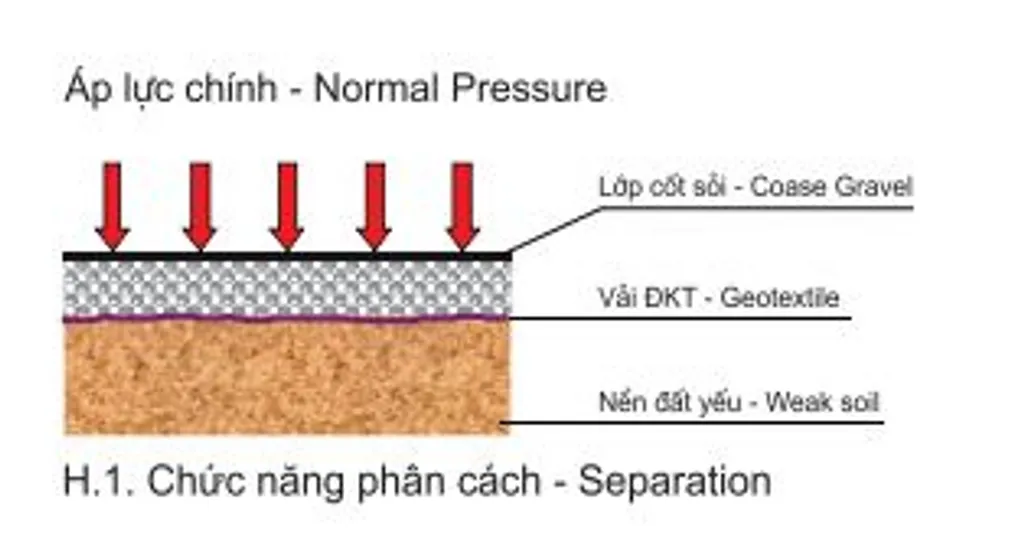
- Stabilising a fill layer over water-saturated soft ground normally requires extra fill thickness to make up for the material lost as it sinks into the soft ground during construction. A separation geotextile placed between the soft ground and the roadbed prevents the two soils from mixing.
- A separation geotextile prevents loss of fill material and therefore saves considerable construction cost.
- It also stops soft soil from intruding into the roadbed aggregate, preserving the mechanical properties of the fill material so the roadbed can absorb and carry the full vehicle load effectively.
Reinforcement
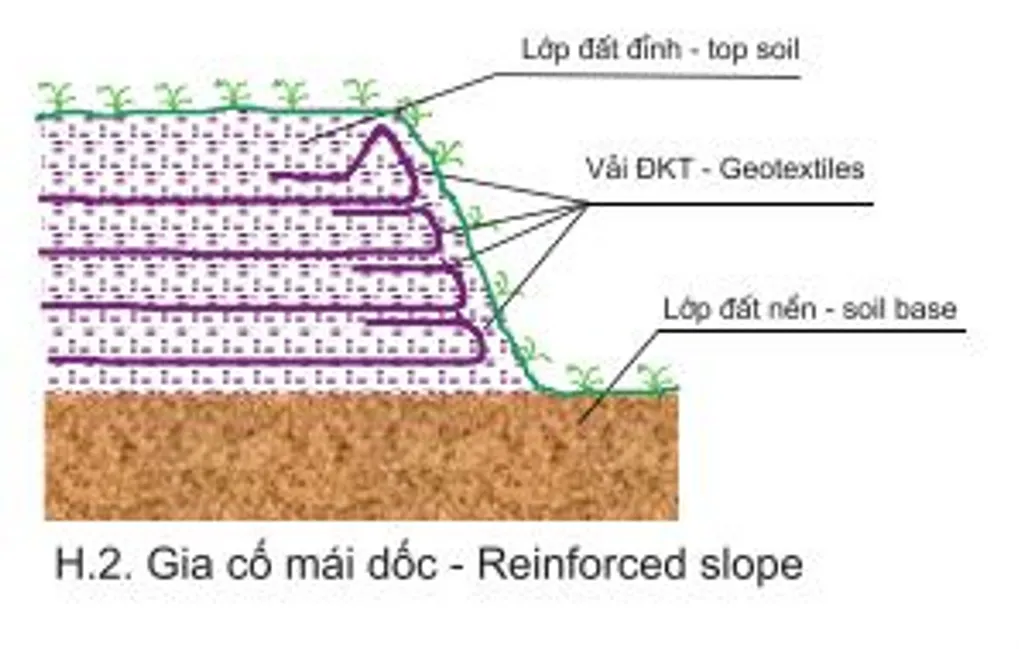
- The geotextile acts as reinforcement, providing horizontal resistance to sliding and so improving slope stability on sections with high fill where slope failure or lateral displacement of the fill is possible — bridge approaches, dyke roads and the like.
- Vehicle loads act on the road foundation mainly in the vertical direction, whereas the geotextile carries tension horizontally. In practice, the bearing capacity of a geotextile-reinforced roadbed comes mainly from the separation function — by preserving the design thickness and the original mechanical properties of the foundation aggregate layers — rather than from any tensile reinforcement of the structure
Drainage / inverted filtration
- On soft ground with high natural moisture content, the geotextile can act as a drain, maintaining and even increasing the shear strength of the subgrade and thereby improving the overall stability of the works over time.
- Needle-punched non-woven geotextiles, being thick and highly permeable, drain well both vertically (normal to the fabric) and horizontally (within the plane of the fabric). This type can therefore dissipate excess pore water pressure quickly during and after construction, increasing the shear strength of the soft subgrade.
Benefits of using geotextiles
Allows the fill layer to be strengthened by improving drainage.
Reduces the depth of excavation into soft strata.
Reduces the required fill slope gradient and increases slope stability.
Keeps settlement rates uniform across the soil layers, particularly in transition zones.
Improves the fill layers and extends the service life of the works.
Design standards for geotextiles
Designing geotextiles for road works with ADSCivil
In road works, geotextiles are used to:
- Wrap the pavement box structural layers
- Wrap the roadbed fill layers
The geotextile definition and application feature built into ADSCivil Road automates almost the whole process for the designer, including:
- Defining and applying the design on the cross section
- Building the 3D BIM model of the geotextile layers
- Computing quantities by two methods — extracting the information from the BIM model, and totalling quantities on the cross sections so that documentation can still be produced the traditional way
Geotextile design
Roadbed geotextile design
The roadbed geotextile is defined by the following parameters:
- The bottom and edge levels of the geotextile layer. These are linked to the levels of the pavement box base lines, the wrapping fill level lines for layers 1, 2 and 3, and the combined excavation base line. To keep the definition of subgrade geotextile layers flexible, ADSCivil Road adds a level offset parameter
- Fold length: the geotextile layers are folded at the edge so that the load from the fill layers above holds them in place
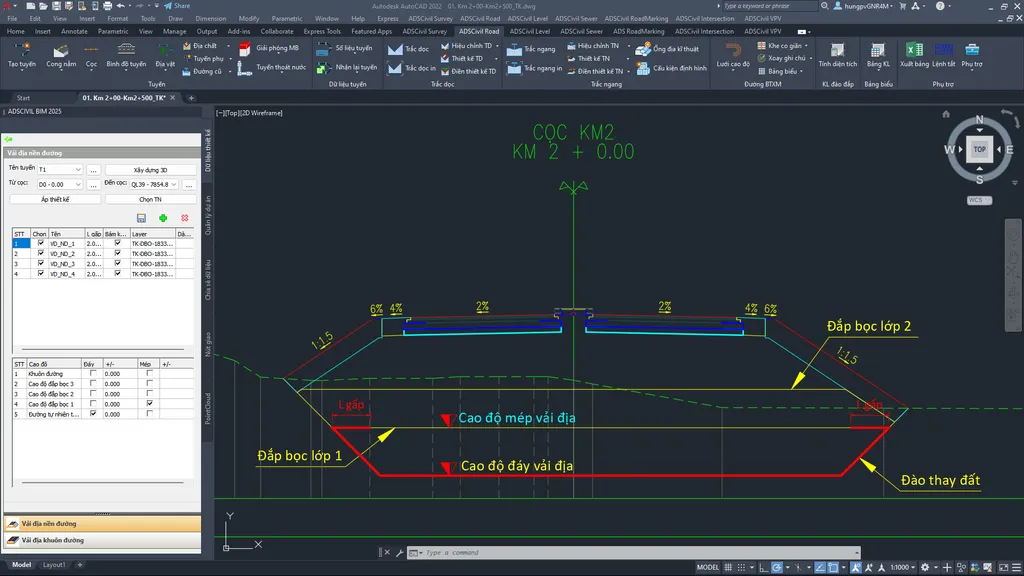
Roadbed geotextile application parameters
Pavement box geotextile design
The pavement box geotextile is defined by the following parameters:
- Wrapping method: wrap each side of the pavement box separately, or run continuously across both sides
- Fold length: the geotextile layers are folded at the edge so that the load from the structural layers above holds them in place
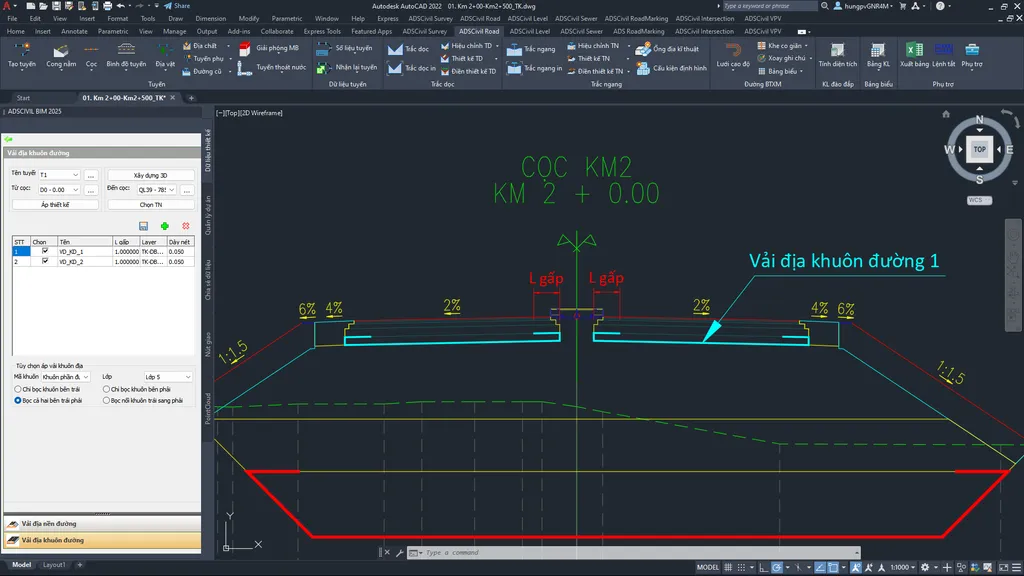
Pavement box geotextile application parameters
Building the 3D BIM geotextile model
The 3D BIM model of each geotextile type is built as a surface object
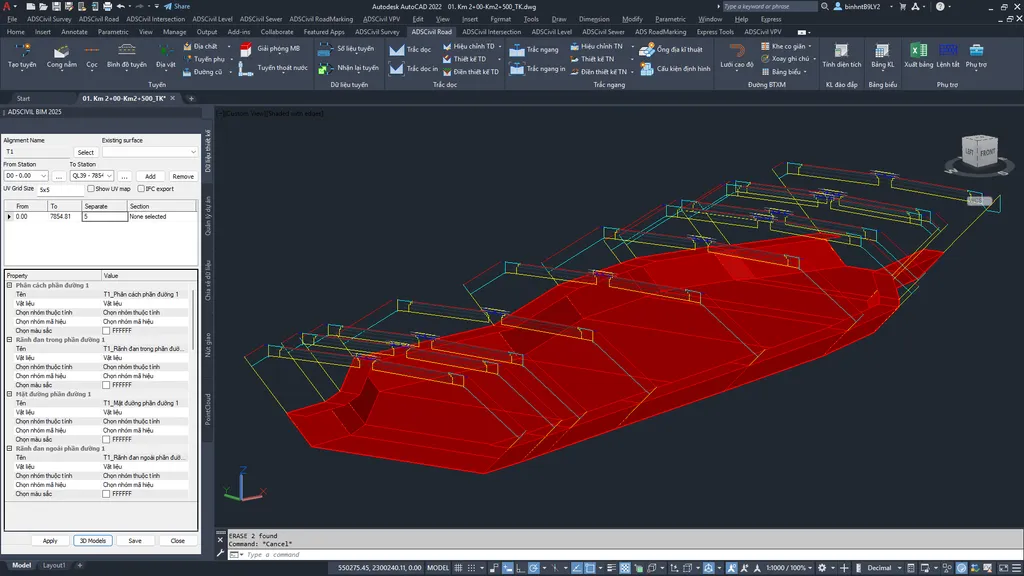
Pavement box geotextile application parameters
Calculating geotextile quantities
Geotextile quantities in the model are looked up automatically through system variables to extract the area
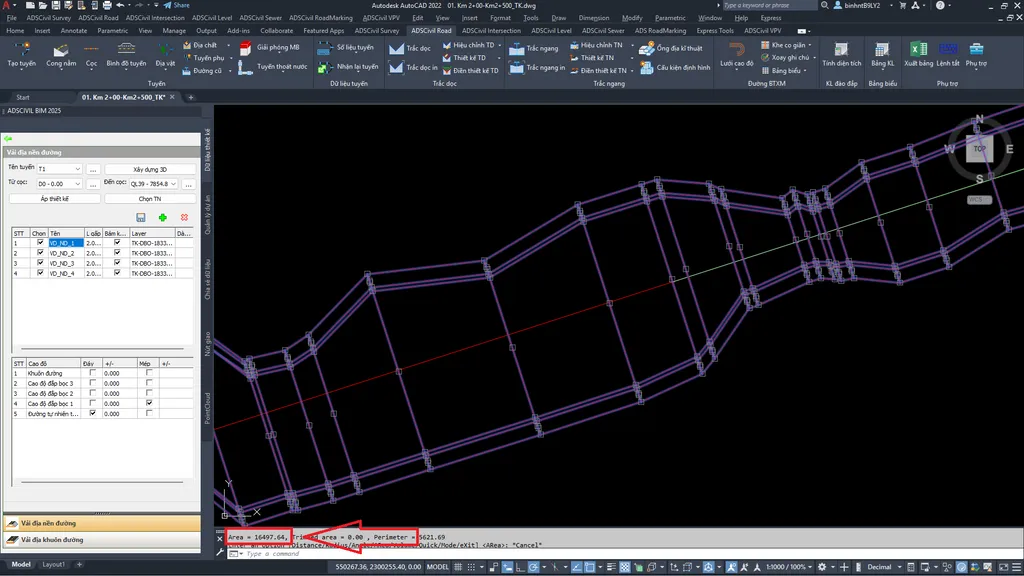
Geotextile quantities on the cross section are totalled from the length measured on the section, multiplied by the length of the route
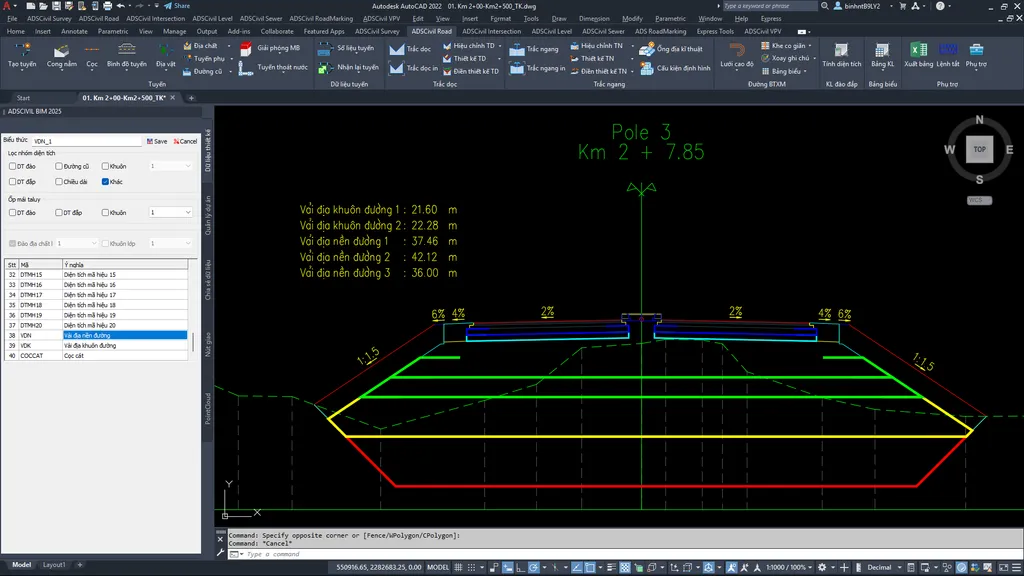
Pavement box geotextile application parameters