 ADSCivil
Part I: The ISO 19650 naming convention
Under ISO 19650-1:2018, an information container is a named, persistent set of information retrievable from within a file storage hierarchy, system or application — for example a sub-directory, an information file (model, document, table, schedule) or a distinct sub-set of an information file (a chapter or section, a layer or symbol). Information containers may be structured (geometric models, schedules and databases) or unstructured (documents, video and audio recordings).
The information in a container must be persistent — that is, it must last long enough to need managing — rather than transient, such as the results of an online search. Naming an information container must follow an agreed common convention. [3]
Naming convention: a container name should as far as possible express the 5Ws + 1H (or 2Hs) and follow the standards and common conventions agreed between the parties, so that on reading a container name the stakeholders can see the relationship (if any) between containers and form a general idea of their content. [6] [8]
Using structured, consistent and intelligible naming conventions for information matters more and more as an increasing volume of information is shared digitally. ISO 19650 recommends that naming an information container should cover three elements: [2] [3] [5] [8]
- (1) A container revision code following an agreed standard, such as IEC 82045-1;
- (2) A status code indicating the permitted use of the information for containers within the CDE;
- (3) Classification attributes in accordance with the framework defined in ISO 12006-2.
Although Vietnam's roadmap for BIM adoption in construction has been formally issued, there are as yet no national standards guiding BIM application, apart from a number of decisions providing guidance (Decision No. 347/QD-BXD of 2 April 2021 publishing detailed guidance on applying BIM to civil works and urban technical infrastructure, and Decision No. 348/QD-BXD of 2 April 2021 publishing general guidance on applying building information modelling) and training materials on BIM application (detailed training and professional development materials published under Decision No. 66/QD-BCDBIM of 6 April 2021).
To name information containers in a CDE, therefore, one may draw on the recommendations of the ISO 19650 series above, together with other material outside that series such as OmniClass and UniClass, in order to establish a naming convention that standardises information exchange between stakeholders and suits the characteristics of Vietnam's construction industry.
The following is reference information on container naming guidance under BS EN ISO 19650-2:2018 & Revised NA 2021, the UK guidance on applying ISO 19650-2 together with the revised national annex issued in 2021:
The United Kingdom developed an information container naming convention which states: "Each information container shall have a unique ID, based on an agreed and documented convention, comprising fields separated by a delimiter".
Container IDs are formed from alphanumeric characters — upper or lower case A-Z and the digits 0-9. The unique ID for containers in the CDE comprises the fields shown in Figure 1 below:

Figure 1. Identifying information containers in the CDE [2]
Where:
- The delimiter normally used is the hyphen "-", the minus sign (Unicode reference U+002D).
- Project: the project field indicates which project the container relates to. A single common project identifier should be established at the start of the project and set out in the project information standard. The project code must be independent of, and clearly distinct from, any internal job number used by the delivery team or the task team.
All parties on the project must use the same project code, fixed in the project information standard. Note that a project may be divided into component projects within the project identifier: where a project comprises several parts, each part may be assigned a different project identifier.
- Originator: the originator field indicates which party is responsible for creating the container, as set out in the detailed responsibility matrix. A unique identifier should be established for each organisation joining the project so as to identify who is responsible for creating the information in the container, and fixed in the project information standard.
- Functional Breakdown: this field indicates which functional aspect of the project the container relates to — a system, a work package or a design topic, for example. A unique identifier should be established for the functional aspects of the container breakdown structure. The functional breakdown may be based on physical subdivision (such as major design elements or systems) or notional subdivision (such as security classification).
The identifiers used must be fixed in the project information standard. The following standard codes should be applied: ZZ — multiple subdivisions apply to this container; XX — no subdivision applies to this container.
For example, functional breakdown identifiers on a bridge project might include codes for abutments, piers, deck and revetment; while on a civil and industrial building project they might include codes for substructure, superstructure, envelope and roof, mechanical systems, electrical systems, public health systems, floor and ceiling systems, internal partitions and finishes.
- Spatial Breakdown: this field indicates which spatial aspect of the project the container relates to — a zone, a location or a level, for example. A unique identifier should be established for each spatial subdivision. The following standard codes should be applied: ZZ — multiple spatial subdivisions apply; XX — no spatial subdivision applies.
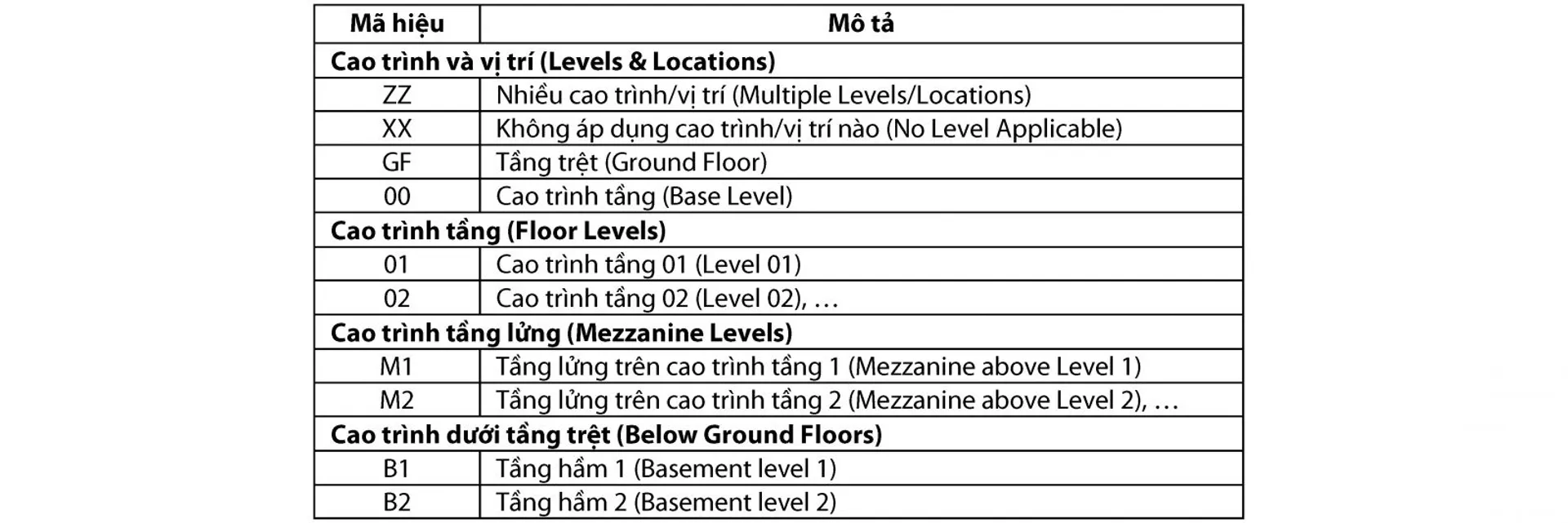
Table 1. Summary of spatial breakdown field codes [2]
- Form: the form field indicates the nature of the container. A unique identifier should be established for each information format, for example:
D - drawing,
M - model, and so on. BS ISO 29845 is used for these codes to avoid duplicating classification metadata.
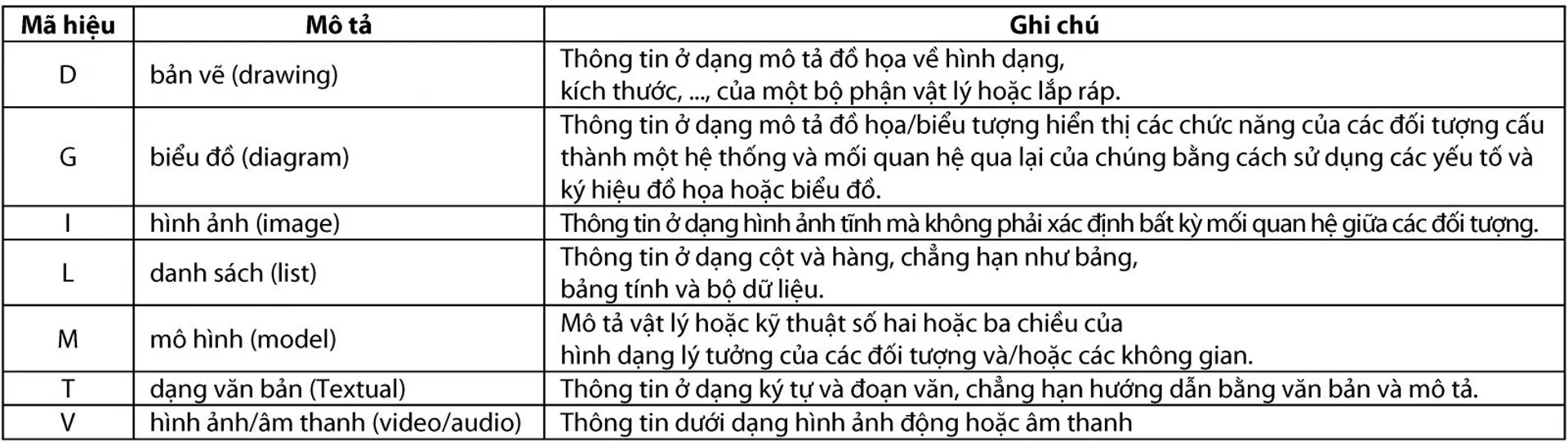
Table 2. Summary of form field codes [2]
- Discipline: the discipline field indicates which discipline is responsible for creating the container. A unique identifier should be established for each discipline whose information relates to the project — for example A for Architecture and B for Building surveying.
Where the information is created by a team on the appointing party's side, such as the client, this field code is used to denote that team's technical discipline. The following standard codes should be applied:
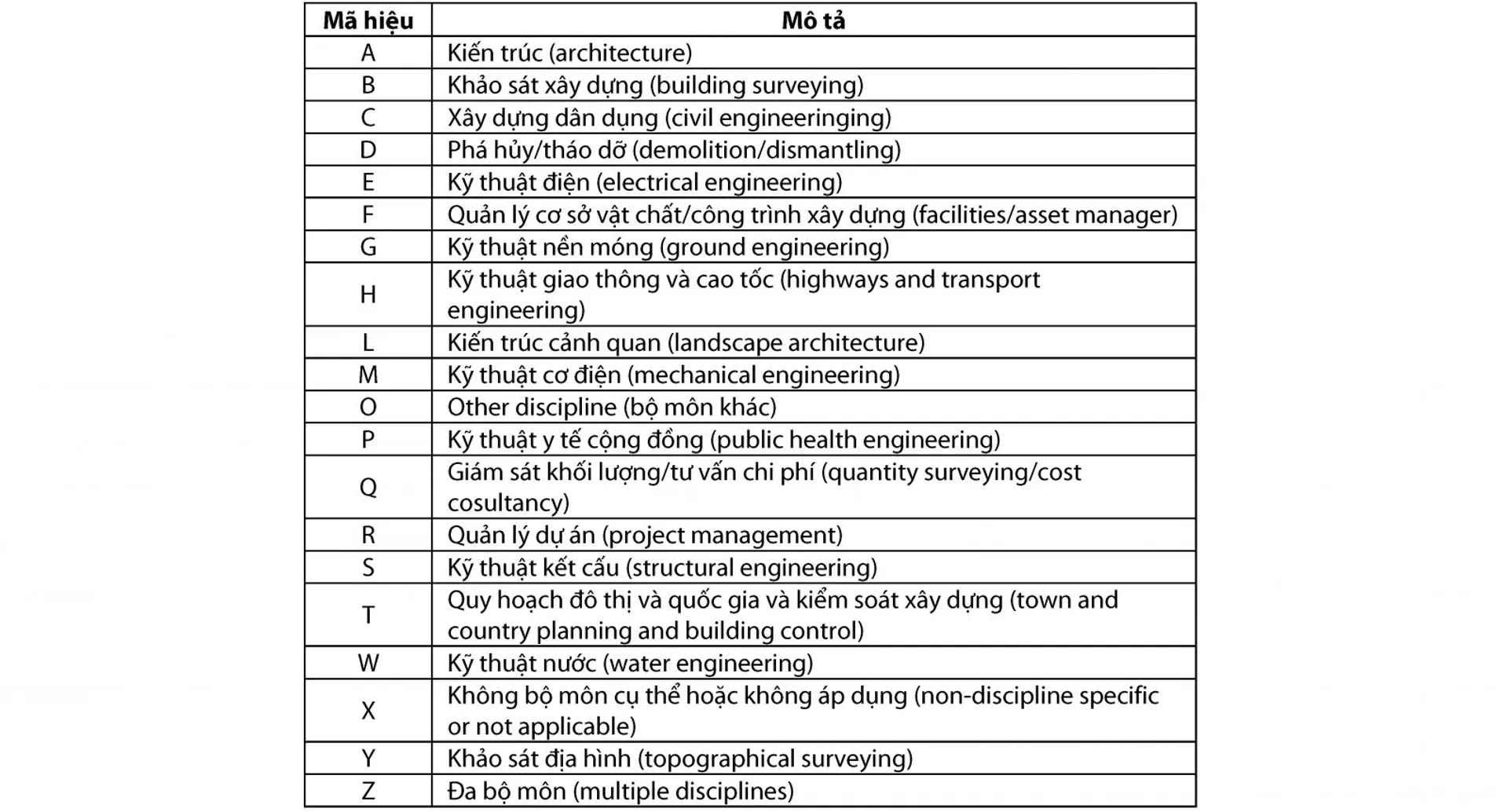
Table 3. Summary of discipline field codes [2]
- Number, or status code: the number field gives the sequential or grouped number that makes the ID unique once all other fields are taken into account. A sequential number should be assigned to each container where it forms part of a series not distinguished by any other field. The numbering scheme is fixed in the project information standard. The container status codes are as follows:
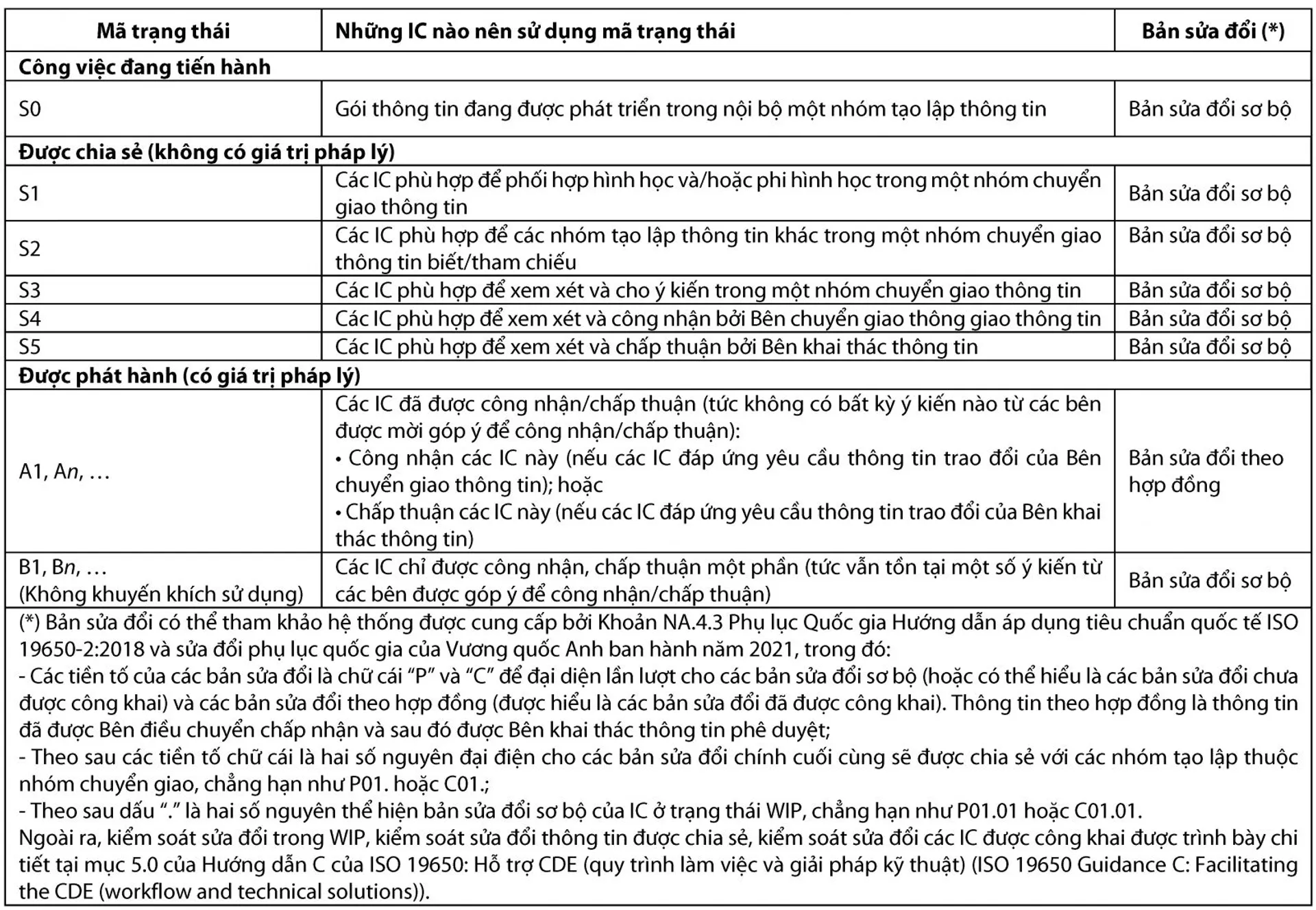
Table 4. Reference table of status and suitability codes for containers in the CDE [2] [7]
"n" refers to the project's information delivery milestones. The list of status codes recommended in Table 4 may be extended, and the extension fixed in the project information standard. The shared status codes (S1-S5) indicate what the containers may be used for. The published status codes indicate whether the containers have been authorised by the delivery team or accepted by the appointing party, but do not explain why they were published.
The project information standard should define the various status codes for containers in the CDE. Note that the list of container status codes recommended in Annex 4.2 of the guidance on applying ISO 19650-2:2018 and the revised UK national annex issued in 2021 may be extended but must not be replaced by project-specific codes, and any such extension must be set out in the project information standard.
Part II: Applying the ISO 19650 naming convention (Decision 348/BXD) in ADSCIVIL CDE
Following ISO 19650 and Decision 348/BXD, ADSCIVIL CDE lets organisations set up the file naming convention to be applied on a BIM project.
Each information container (folder or file) has a unique name based on a previously agreed convention, comprising fields separated by a "-", with each field assigned a value from an agreed coding standard.

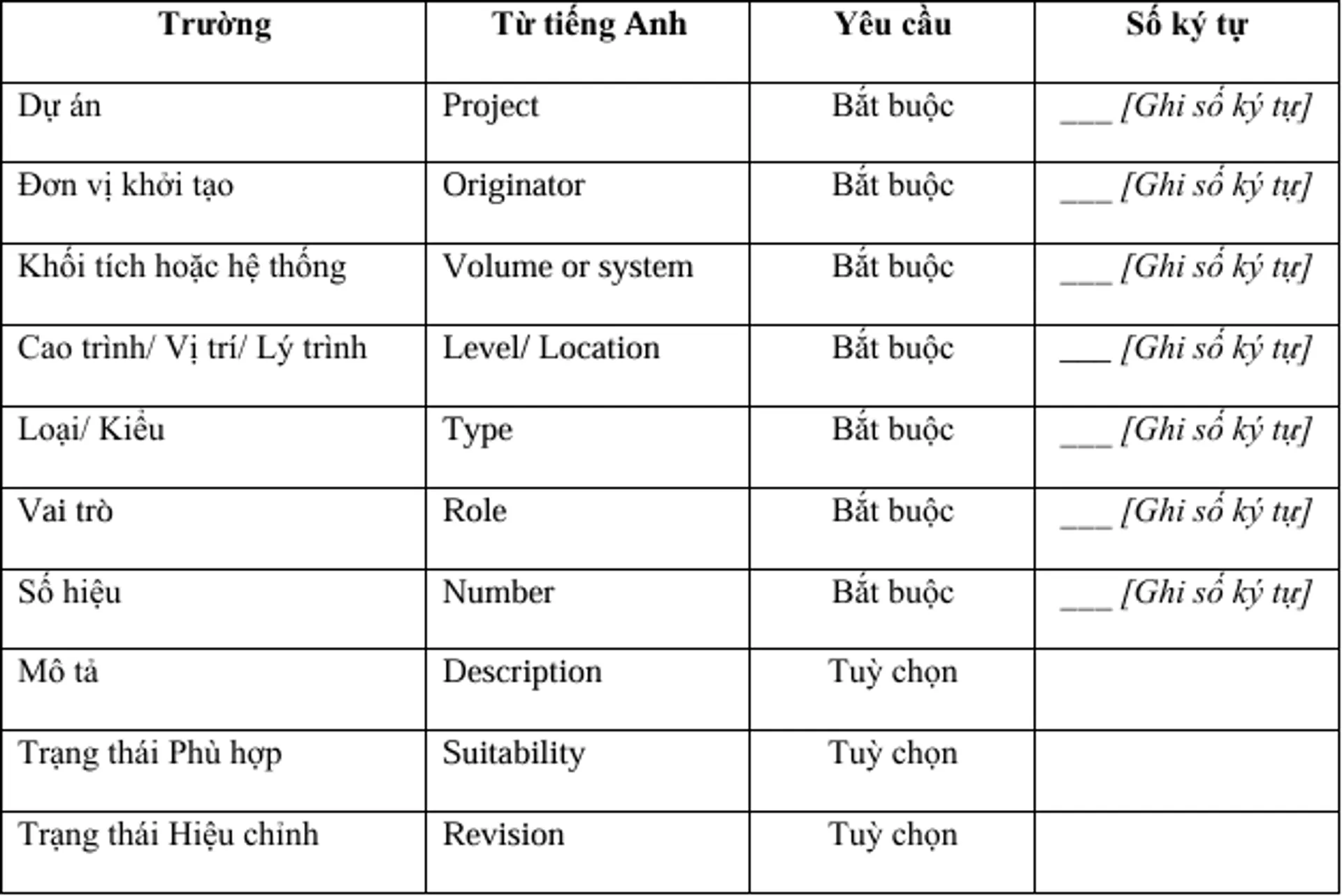
Table 5. Breakdown field codes under Decision 348/BXD
The file naming convention in ADSCIVIL CDE is thus designed on the basis of the international standard and the Ministry of Construction's regulations. Below is the interface for setting up the convention in the CDE for a BIM project:
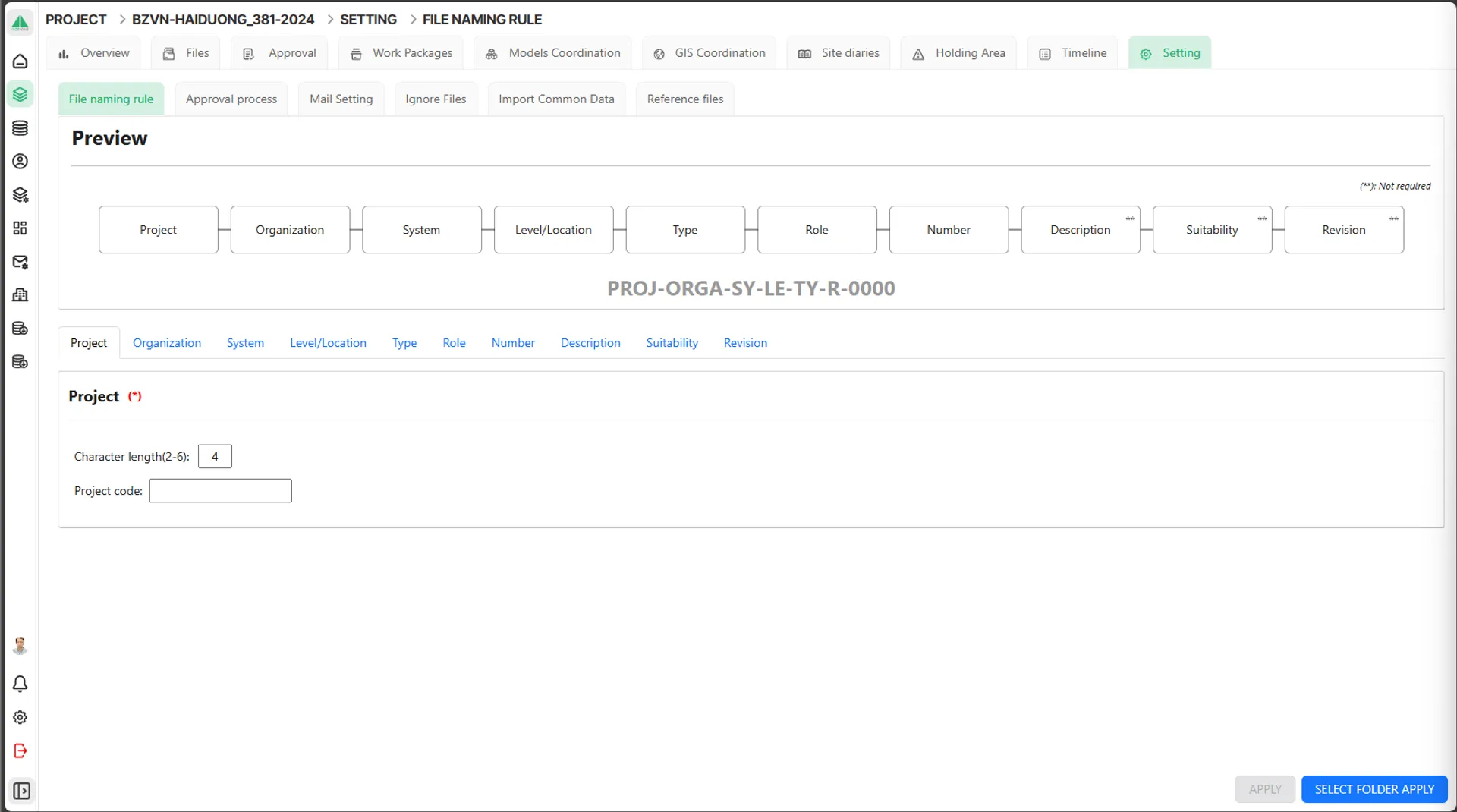
The naming convention is applied in ADSCIVIL CDE as follows:

The file name comprises two kinds of field: "Mandatory" and "Optional":
The mandatory fields are:
- Project: identifies the project being delivered (4-6 characters).
Example:
CT01: Expressway project 01 from city A to city B
- Organization: identifies the organisation responsible on the project (3-6 characters).
Example:
BZS: Baezeni Soft Co., Ltd
BZVN: Baezeni Vietnam Co., Ltd
- System: identifies the system or work item within the project (2 characters).
Example:
AR: Architectural works item
BR: Bridge works item
LS: Lighting system item
- Level/Location: identifies the location within the project (2 characters).
Example:
Km1+237: project location at Km1+237
Km1+379: project location at Km1+379
- Type: identifies the file type
Example:
M2: 2D model file
M3: 3D model file
- Role: identifies the role of the project team member (1-2 characters).
Example:
A: Architect
B: Site supervisor
C: Design engineer
- Number: identifies the number of the project work item (4-6 characters).
The optional fields are:
- Description: a general description of the project (0-160 characters).
- Suitability
- Revision
Applying the naming convention therefore produces a file name such as:
CT01-BZS-BR-Km1+237-M3-C-0001
A file named to this convention conveys the following information:
CT01: the North-South Expressway project
BZS: the organisation delivering and responsible for the work - Baezeni Soft Co., Ltd
BR: bridge works item
Km1+237: the item is located at Km1+237
M3: the item is a 3D model file
C: the item is the design engineer's responsibility
0001: the number of the bridge item within project CT01
Naming every file to this convention lets users grasp the basic information about a file, including members who join the team later. Everyone on the project can then exchange information easily throughout delivery.
Part III: Conclusion
In managing information on a BIM-enabled construction project, the CDE plays an important role in storing, retrieving and using project information effectively. The project's stakeholders must therefore agree a naming convention for information containers that is systematic, standardised and unique within the CDE and appropriate to the particular project.
This helps stakeholders understand and identify the content of information containers in the CDE quickly and accurately, and supports effective organisation, communication and retrieval of information — a significant contribution to the effectiveness of project information management.
Drawing on ISO 19650-2:2018, the guidance on applying ISO 19650-2:2018, the revised UK national annex issued in 2021 and other related material, this article clarifies the underlying principles and sets out guidance on naming information containers in a CDE — helping to improve flexibility, adaptability and consistency, and to optimise information management on BIM-enabled construction projects.
REFERENCES
[1] Vuong Thi Thuy Duong, Vo Le Duy Khanh, Tran Quang Phu, Tran Thi Quynh Nhu, Nguyen Nguyen Khang (2023). Applying Building information modelling (BIM) from a project lifecycle perspective. Proceeding Conference: International Conference “Construction Science and Technology toward Sustainable Development”, pp. 56-62, DOI: 10.59382/pro.intl.con-ibst.2023.ses1-2.
[2] British Standards Institution (2021). BS EN ISO 19650-2:2018 & Revised NA Organization and digitization of information about buildings and civil engineering works, including building information modelling (BIM) - Information management using building information modelling - Part 2: Delivery phase of the assets.
[3] International Organization for Standard (2018) ISO 19650-1:2018 Organization and digitization of information about buildings and civil engineering works, including building information modelling (BIM) - Information management using building information modelling - Part 1: Concepts and principles.
[4] International Organization for Standard (2018) ISO 19650-2:2018 Organization and digitization of information about buildings and civil engineering works, including building information modelling (BIM) - Information management using building information modelling - Part 2: Delivery phase of the assets.
[5] The UK BIM Framework, website: https://www.ukbimframework.org/.
[6] Nguyen Phuoc Thien (2022). Building Information Modeling (BIM) - Application to building projects in Vietnam;
[7] Vuong Thi Thuy Duong, Vo Le Duy Khanh, Tran Quang Phu, Tran Thi Quynh Nhu, Nguyen Nguyen Khang (2023). The common data environment under ISO 19650, Journal of Construction, No. 10/2023, pp. 108-112.
[8] Vuong Thi Thuy Duong, Tran Quang Phu, Vo Le Duy Khanh, Tran Thi Quynh Nhu, Nguyen Nguyen Khang (2023). Information management on construction investment projects (Applying BIM under ISO 19650). Construction Publishing House, 256 pages.