 ADSCivil
For construction investment projects, the total investment figure is always one of the most important pieces of information. It is made up of many components: site clearance compensation, construction costs for the works quantities, equipment costs, financing costs and so on.
The cost items that account for the largest share of total investment — site clearance, construction costs and roadbed earthworks — are prepared and calculated from the quantity take-off schedule. Every small error in that take-off translates into a very large error in the total investment figure, once the many statutory coefficients and percentages have been applied.
Quantity take-off therefore plays a critical role and is an essential requirement on any construction investment project, whether infrastructure or building. For this reason, the take-off method and the resulting quantity schedule are always the most closely scrutinised part of design appraisal — particularly on transport and technical infrastructure projects, where earthwork volumes are enormous.
How have we been calculating roadbed cut and fill quantities?
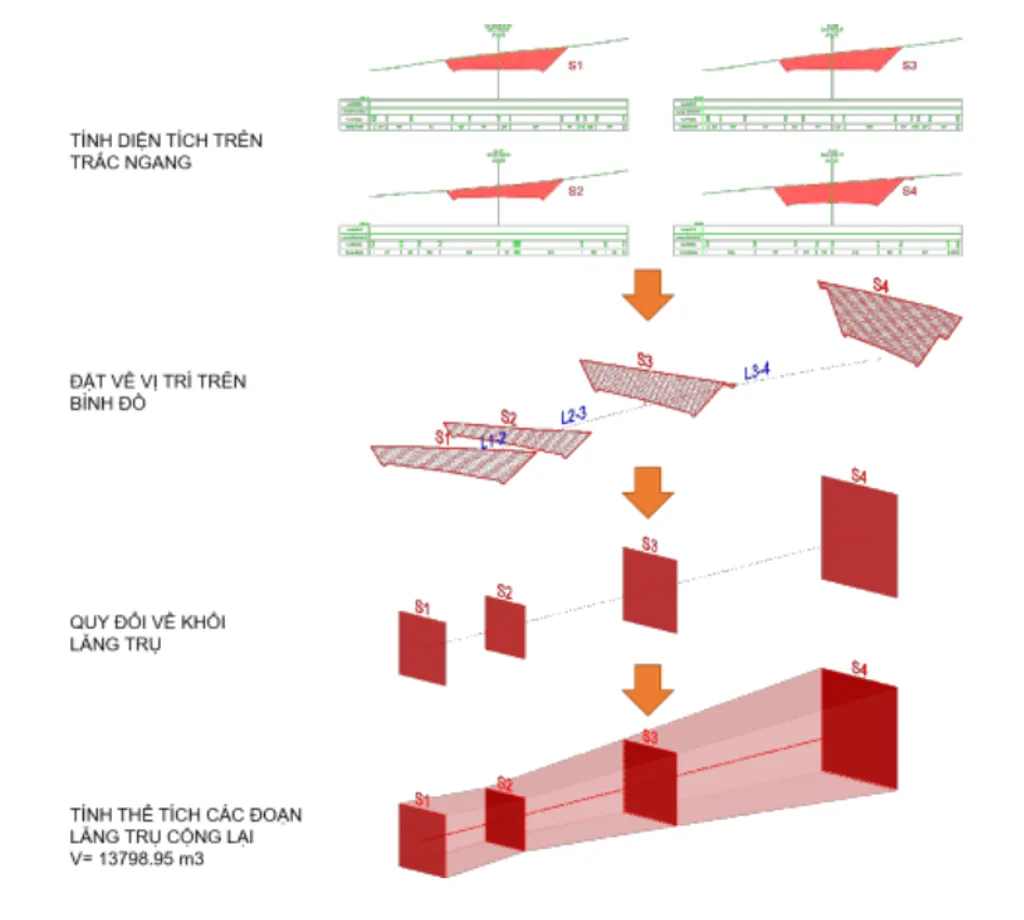
The traditional approach approximates the cut and fill mass as a set of basic geometric solids so that volume formulas can be applied easily:
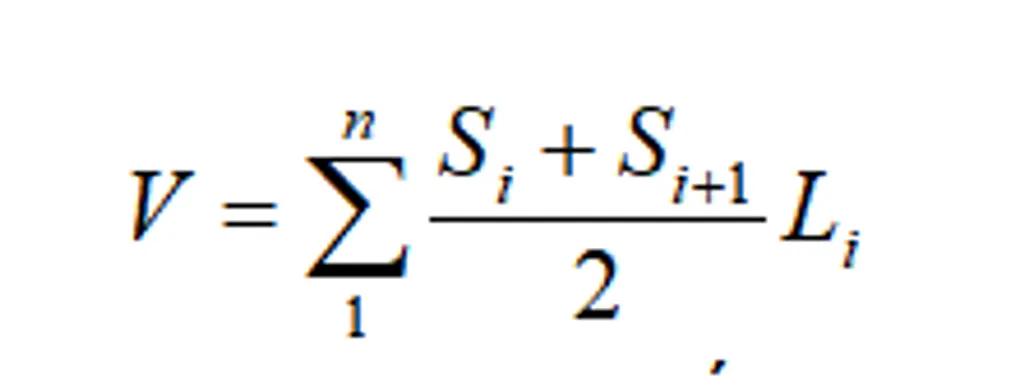
In effect, the cut and fill mass is treated as a series of prisms whose two end areas equal the areas measured on the cross sections and whose height equals the chainage interval between them
The limitations of this method are:
- The quantities are "hidden" behind bare numbers; scanning the schedule gives little sense of which sections or locations need design adjustment
- The margin of error is substantial. This drives quantity variations during actual construction, contractors routinely have to seek approval for additional costs, and the project schedule suffers.
- No model is produced for BIM
The solution:
With the rapid growth of Building Information Modeling (BIM) in construction, applying BIM to quantity take-off and project management has become increasingly common. Modern BIM software can extract element and component quantities automatically from the 3D model, quickly and easily. Because the information updates instantly whenever the model changes, BIM has significantly improved the accuracy of cost estimation.
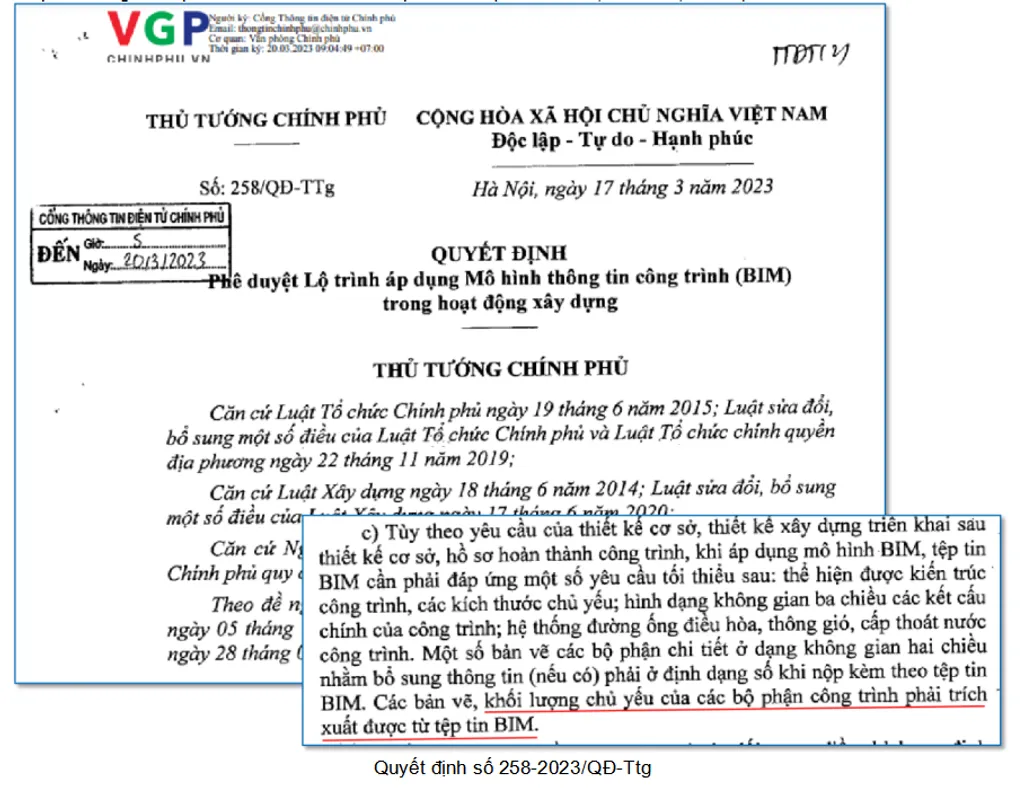
On the legal side, Decision 258/QD-TTg "Approving the roadmap for applying Building Information Modeling (BIM) in construction activities" requires that "the drawings and principal quantities of the works' components must be extracted from the BIM file" (Article 1, Clause 2, Point c).
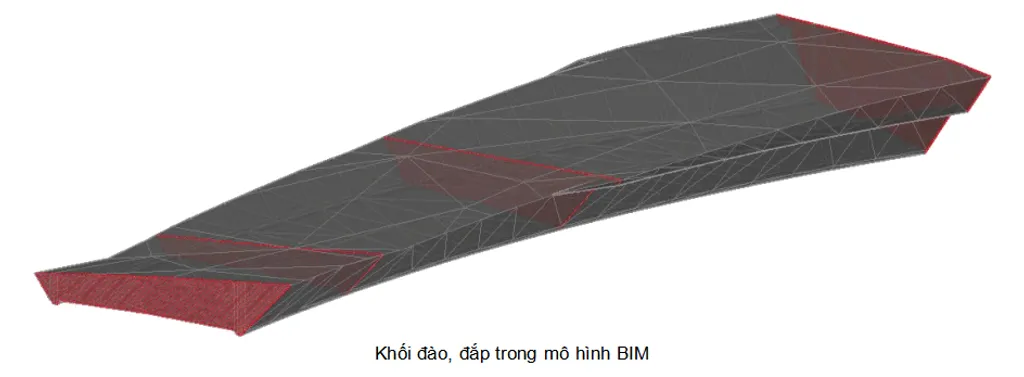
Building road cut and fill solids in ADSCivil BIM
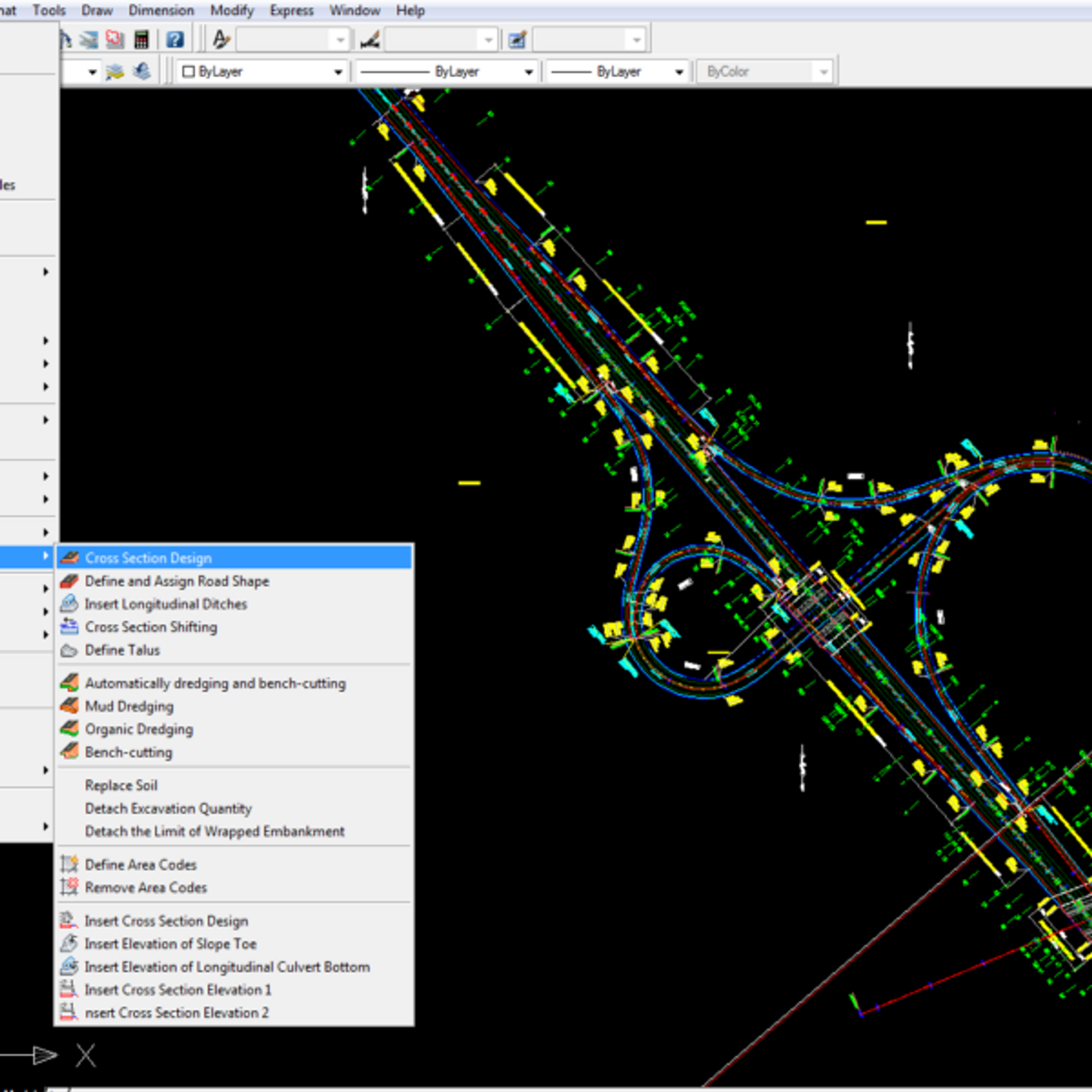
ADSCivil supports three ways of building solids
- Type 1 solids (surface to surface): created between an upper and a lower surface, typically used to build cut or fill solids such as:
Cut solids: slope excavation, pavement excavation, shoulder excavation, mud removal and so on, where the upper surface is the existing ground and the lower surface is the design surface of the slope, pavement and so on
Fill solids: slope fill, pavement fill and so on, where the upper surface is the design surface of the slope or pavement and the lower surface is the natural ground
Solids between geological strata, where the upper and lower surfaces are the stratum boundaries
- Type 2 solids (section to section): created between consecutive cross sections, typically used for design solids that follow the alignment — pavement structure, kerbs, channel drains, retaining walls and so on
- Type 3 solids: composite solids that users assemble from the basic solids to suit specific requirements. These composite solids are used for:
Fill quantities net of the pavement box, longitudinal culverts, retaining walls and so on. For example, slope fill is composed of the fill solid up to the finished slope face minus the slope protection solid; pavement fill is composed of the fill solid up to the pavement minus the pavement box solid.
Cut quantities split by geological stratum. For example, rock-stratum subgrade fill is obtained from the intersection of two solids: the subgrade fill solid and the rock stratum solid.
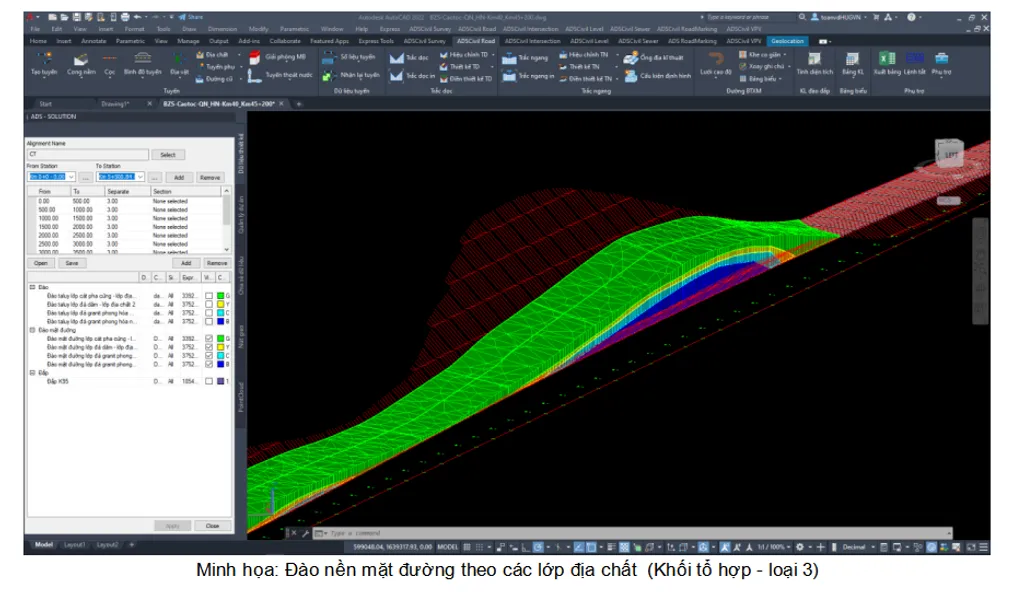
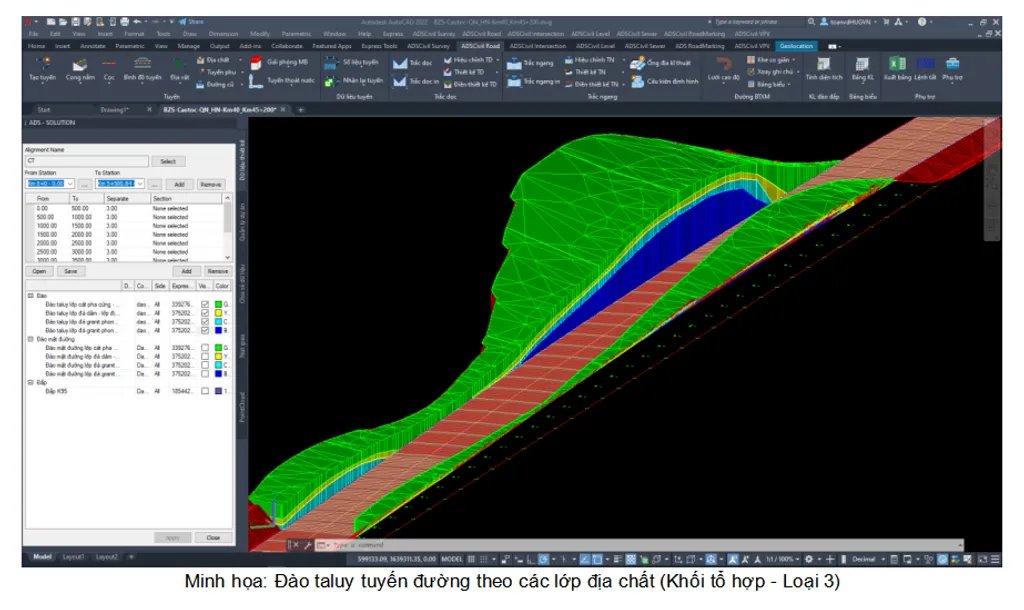
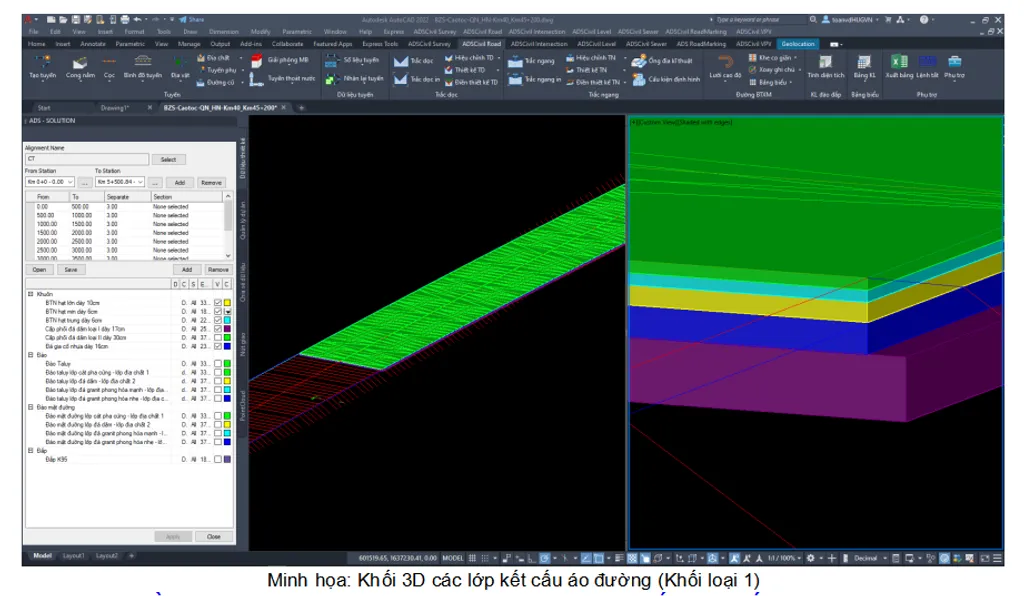
Assessing this approach to BIM modelling of cut and fill solids
Compared with the traditional approach, the BIM model built in ADSCivil offers a number of clear advantages:
- A model ready for BIM coordination meetings
Issues are easy to spot and resolve when all stakeholders review them together and make decisions against a single visual model
- Fully accurate quantities:
Unlike other applications that only generate design surfaces, ADSCivil builds the detailed geometry of the earth and rock masses themselves, which is what makes it possible to read volumes directly from the model
From the basic solids, users can readily assemble composite solids. Even after they have been edited, ADSCivil still recognises the solids and extracts quantities from the model automatically
- Accurate cut and fill limits:
Because the solids intersect the existing and design surfaces precisely, the site clearance limits and the project's land take are represented accurately. Social welfare issues can then be addressed from the project preparation stage onwards
- More effective construction planning and site organisation
Accurate quantities also make construction programmes more specific and more reliable. During construction, contractors can readily see the quantities for each section of the route and set the most appropriate schedule and methods based on their plant capacity
Conclusion:
A BIM-based road earthworks model is highly visual and is produced quickly and with full accuracy from the survey data. Design outcomes can therefore be assessed more precisely, and comparing alternative options becomes much easier. THIS HELPS DESIGNERS MAKE ACCURATE DECISIONS.
Demo video: https://youtu.be/USbOW0yPmnI?feature=shared
TRY IT FREE: https://adscivil.vn/campain/625680658ae6709118ca2727/
BAEZENI SOFTWARE CO., LTD
Address: 2nd Floor - CT1AB Building, Me Tri Plaza, Nam Tu Liem Dist, Hanoi City
Hotline: 024.3200.5386 - 0987 779 228
Web: https://adscivil.vn/